
Food Ingredient Insights & News
Explore technical formulation guides, market trends, and industry articles curated by NCC Food Ingredients specialists.
7 Tips for Choosing Bakery and Confectionery Ingredients?
Table of Contents
- Identify the Product’s Purpose and Required Ingredients
- Evaluate Ingredient Quality, Freshness, and Consistency
- Check Functionality and Compatibility in Recipes
- Verify Safety, Allergen Information, and Supplier Standards
- Compare Cost, Shelf Life, and Storage Requirements
- FAQS
- Conclusion
- Related Posts
Choosing Bakery and Confectionery Ingredients is not simply a matter of price or an attractive label. Flour, fats, sugars, cocoa, dairy, and leavening agents each influence a product’s crumb, flavor, color, and shelf life. A dependable choice starts with the recipe and the production process. A soft sandwich loaf, glossy ganache, and crisp biscuit all demand different ingredient performance.
Small details matter. Flour protein can affect dough strength, while cocoa’s fat content may change a filling’s texture. Storage conditions count, too: warm rooms can soften fats, and humidity can make sugar clump. Supplier specifications are useful, but they may not answer every practical question. Request clear product details, allergen information, and guidance on substitutions. Then test samples in a representative recipe. Record mixing time, bake loss, flavor, and texture after cooling. It can feel overly meticulous. It also reduces guesswork.
These seven tips explore how to compare quality, consistency, functionality, sourcing, and cost before committing to a purchase. Check whether an ingredient performs reliably across batches, not just in one promising trial. Consider packaging and storage needs, especially if ingredients will be opened and handled repeatedly. Ask suppliers about availability and how they communicate product changes. A lower price can be appealing, but inconsistent results may create waste or extra labor. And a sample can still surprise you. Keep room for practical judgment: a technical specification helps, but your own test batch reveals how the ingredient behaves in your bakery.
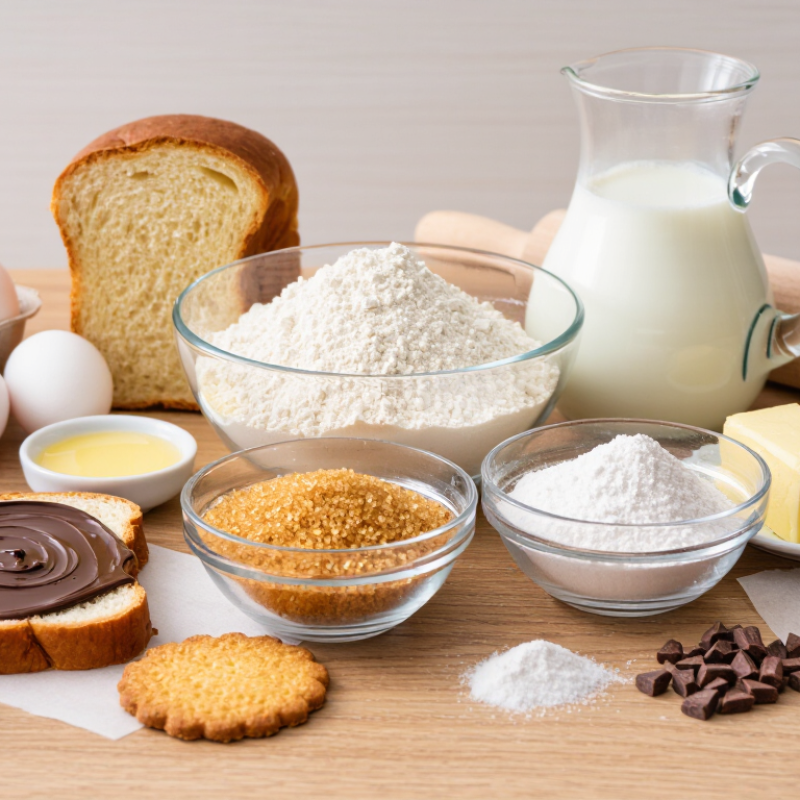
Identify the Product’s Purpose and Required Ingredients
Before selecting ingredients, define the product’s job. A crisp cookie needs a different balance from a soft cake or a chewy caramel. Decide on texture, sweetness, shelf life, and baking method. Then list what each ingredient must do: flour builds structure, fat tenderizes, and leavening creates lift. That changes everything.
Check the numbers, not just the recipe name. USDA FoodData Central lists enriched all-purpose flour at about 364 calories and 10.3 grams of protein per 100 grams. Its composition can affect structure and moisture, though flour performance also varies by type and handling. The database lists unsweetened cocoa powder at about 228 calories per 100 grams, with substantial fiber. That matters when cocoa adds flavor and absorbs moisture. These figures describe nutrient composition, not how an ingredient behaves in every formula.
For a bakery trial, write down the target before weighing anything: “thin, crisp edges” is more useful than “better cookie.” For confectionery, specify whether a filling must pipe cleanly, hold its shape, or stay soft after cooling. Read ingredient specifications for particle size, fat content, and moisture where available. I still sometimes choose an ingredient by habit, then wonder why the batch changed. Small test batches help. Change one variable at a time, record the result, and revisit the purpose if the texture misses the mark.
Evaluate Ingredient Quality, Freshness, and Consistency
Tip 1 Check quality before ordering in bulk. Flour should look dry and smell clean, without musty notes or visible clumps. Butter should have an even color and a fresh, mild aroma. Small details matter.
Tip 2 Verify freshness and storage conditions. Ask when an ingredient was packed and how it was stored. For nuts, seeds, and dried fruit, check for rancid odors or unusual softness. Keep batch dates, then compare samples over time. A tidy label helps, but it cannot tell the whole story.
Tip 3 Test consistency in your own recipes. Bake a small batch with each new delivery, using the same scale, mixing time, and oven settings. Note dough texture, spread, rise, and final flavor. If a pastry suddenly absorbs more liquid, the flour may differ in moisture or grind. That is useful evidence, though not proof by itself. Supplier specifications and quality records can add context. I once treated a slightly darker sugar as a harmless variation; the finished icing tasted more toasted than expected. Taste matters. A simple log can catch patterns before they affect a full production run.
Check Functionality and Compatibility in Recipes
An ingredient can look ideal on paper and still behave differently in a finished bake.
Check what it does in the recipe, not only its label or price. High-protein flour may give bread more structure, but it can make a tender cake feel firm. Fat matters too: a butter substitute with more water may spread cookies and soften their edges. Small changes matter.
Compatibility often depends on moisture, acidity, and temperature. Cocoa can absorb liquid, while honey may add both sweetness and moisture. If replacing one ingredient, adjust only one variable at a time. Test a small batch. Compare mixing texture, bake time, spread, rise, and the cooled product.
A batter that looks slightly thicker may still bake well, but record the result rather than relying on memory.
For leavening, check whether the recipe provides the acid needed to activate baking soda. For fillings, consider whether a fruit puree will release water during baking and affect the crust.
Keep notes on ingredient weights, room temperature, and changes in method. Even careful notes miss things sometimes. That is a reason to repeat a promising test, not to assume the first result will hold.
When several ingredients change together, it becomes difficult to tell which one caused the difference.
Verify Safety, Allergen Information, and Supplier Standards
7 Tips for Choosing Bakery and Confectionery Ingredients?
Verify Safety, Allergen Information, and Supplier Standards
Ingredient selection should begin with evidence, not attractive packaging. Request a current specification, full ingredient list, allergen declaration, lot code, and certificate of analysis. Compare the documents with the sack label and delivery docket. Paperwork matters. The World Health Organization estimated that unsafe food caused 600 million illnesses and 420,000 deaths worldwide in 2010, highlighting the value of dependable food-safety controls (WHO, Estimates of the Global Burden of Foodborne Diseases, 2015).
For allergens, ask suppliers about shared equipment, cross-contact controls, cleaning checks, and advance notice of recipe changes. Confirm declarations against each delivery; a familiar ingredient can change. The U.S. Centers for Disease Control and Prevention reported that about one in 13 U.S. children has a food allergy (CDC, Voluntary Guidelines for Managing Food Allergies in Schools, 2013). That figure is a reminder that a small label discrepancy can matter greatly to customers.
Review supplier audit records, traceability procedures, and how issues are handled. Codex Alimentarius’ General Principles of Food Hygiene, revised in 2022, outlines preventive food-safety practices, including HACCP-based controls. A certificate is useful, but it does not prove every shipment is identical. Keep samples and records where practical, and ask questions when documents feel incomplete. Even experienced buyers can overlook a quiet specification change.
Compare Cost, Shelf Life, and Storage Requirements
When comparing bakery and confectionery ingredients, look beyond the price on the bag. A lower-cost cocoa powder may need a larger quantity to deliver the same color or flavor. Compare cost per usable batch, including trimming, waste, and how consistently the ingredient performs. Small batches help. Record the amount used, finished yield, and any changes in texture. Supplier specifications can clarify fat content, moisture, and pack size, but test the ingredient in your own recipes before making a large purchase. A spreadsheet is useful, though it cannot capture every difference in taste.
Shelf life depends on the ingredient and its handling. Check the date on unopened goods, then note how long they remain suitable after opening. A large bag of nuts may cost less per kilogram, but turn rancid before a small bakery can use it. Consider storage, too: flour needs a dry, sealed space, while chocolate can develop a dull surface after temperature swings. Keep ingredients away from heat, moisture, and strong odors, and follow the supplier’s storage guidance. Use dated labels and rotate older stock forward. This sounds simple. It is easy to skip when orders pile up. Review the plan during a quiet week: are you saving money, or just buying more than your shelves and recipes can handle?
FAQS
Check that flour is dry, clean-smelling, and free of clumps. Butter should have an even color and mild aroma. Small details matter.
Ask when ingredients were packed and how they were stored. Check nuts and dried fruit for rancid odors or unusual softness. Keep batch dates.
Bake a small batch using the same scale, mixing time, and oven settings. Record texture, spread, rise, and flavor. Taste matters.
Request current specifications, ingredient lists, allergen declarations, lot codes, and analysis records. Compare them with the sack label and delivery details. Paperwork helps.
Ask about shared equipment, cleaning checks, and cross-contact controls. Confirm the declaration with every delivery. Ingredients can change quietly.
No. Review traceability procedures, audit records, and how problems are handled. Keep samples where practical. I can still miss a small change.
Compare cost per usable batch, including waste and the amount needed for flavor or color. Record finished yield. A spreadsheet helps, but taste is harder to capture.
Check shelf life after opening and whether your storage space suits the ingredient. Dated labels and rotating older stock forward can help. Easy to forget.
Keep flour sealed and dry. Protect chocolate from temperature swings, which can leave a dull surface. Avoid heat, moisture, and strong odors.
Conclusion
Choosing the right Bakery and Confectionery Ingredients begins with understanding what you plan to make and the role each ingredient must play. Consider the recipe’s needs, such as flavor, texture, structure, or decoration, then assess ingredient quality, freshness, and consistency. Reliable ingredients help produce more predictable results from one batch to the next.
Before purchasing, check that ingredients work well together in your recipes and review safety details, including allergen information and the supplier’s quality standards. Compare prices alongside shelf life and storage requirements, since an affordable option may not be economical if it spoils quickly or needs special handling. A thoughtful balance of purpose, performance, safety, and value can help you select ingredients that support both dependable baking and efficient kitchen planning.

Blog Tags: