
Food Ingredient Insights & News
Explore technical formulation guides, market trends, and industry articles curated by NCC Food Ingredients specialists.
What Are the Best Natural Flavouring Ingredients from China?
Table of Contents
- How China Defines Natural Flavours Under ISO 9235 and GB 2760
- Why Citrus Oils Rank Highly: Limonene Profiles Verified by GC–MS
- Tea, Jasmine, and Osmanthus Extracts: Key Volatile Compounds and Data
- Chinese Spice Oleoresins: Capsaicin, Anethole, and Extraction Yields
- How to Compare Ingredients Using Sensory Scores, Stability Tests, and COAs
- FAQS
- Conclusion
- Related Posts
Choosing the best Natural Flavouring Ingredients from China requires more than comparing aroma strength or price. The right ingredient should perform consistently, suit the product, and meet documented food-safety requirements. China offers a remarkable botanical range, shaped by varied climates, farming traditions, and regional processing expertise.
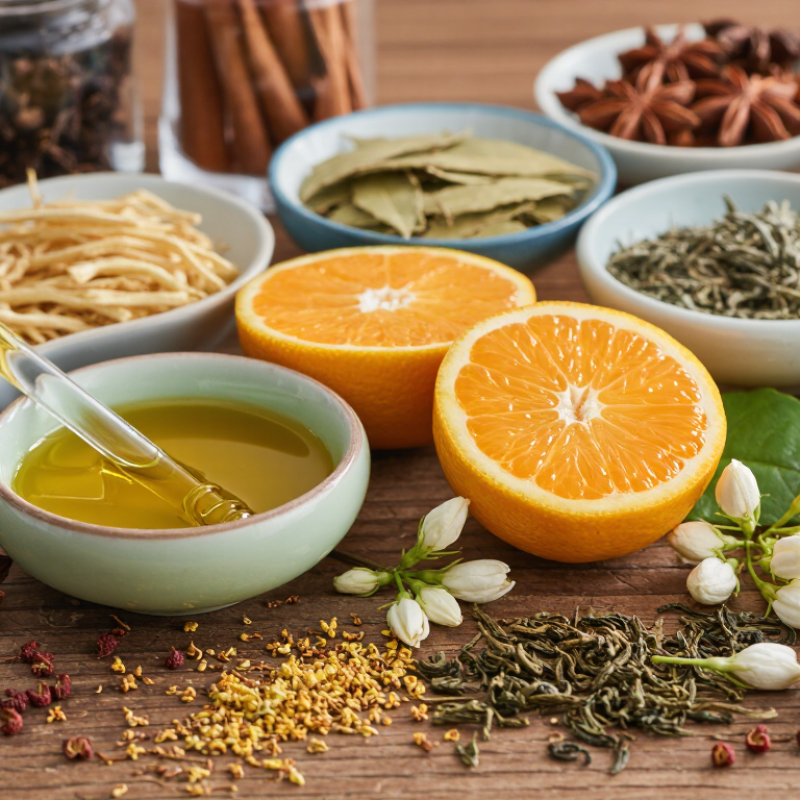
Bright citrus oils from Sichuan and Yunnan can add fresh peel notes to beverages, confectionery, and sauces. Osmanthus provides a soft apricot-like aroma, while jasmine delivers a delicate floral character. Ginger, green tea, star anise, and Sichuan pepper offer deeper profiles. Each ingredient behaves differently. Extraction method matters greatly.
Small details become important here. A cold-pressed citrus oil may smell vivid and sharp. A steam-distilled version can appear cleaner and lighter. Dried ginger may bring warmth, but its intensity can change between harvests. This is where practical evaluation helps. I would compare samples in the finished formula, not only on a paper specification.
“Best” is never universal.
Reliable sourcing also depends on traceability, botanical identification, pesticide controls, allergen statements, certificates of analysis, and suitable storage. Reputable suppliers should explain origin, extraction, batch variation, and shelf-life conditions. Independent testing may still be wise, especially for concentrated oils and complex extracts.
Some assumptions deserve reconsideration. A stronger aroma is not always better. The lowest price may create higher formulation costs later. Even attractive samples can disappoint after heating, dilution, or extended storage. A careful introduction to China’s natural flavouring sector should therefore balance sensory appeal with evidence, technical performance, and responsible quality verification.
How China Defines Natural Flavours Under ISO 9235 and GB 2760
China offers diverse natural flavouring ingredients, including citrus oils, ginger extracts, tea distillates, osmanthus extracts, and vanilla materials.
Their appeal comes from recognizable sources and regional processing knowledge. However, “natural” is not simply a marketing word. It requires technical evidence.
Under ISO 9235, natural flavouring substances come from plant, animal, or microbiological sources.
Their production should use physical, enzymatic, or microbiological methods. Chemical identity alone is not enough. The source and processing route both matter. A citrus peel extract may fit the natural category, but its carrier, concentration, and final use still need review. ISO 9235 helps describe the ingredient. It does not replace Chinese market approval.
In China, GB 2760 is central to compliance.
It lists permitted food additives and flavouring substances, with conditions for use in specific food categories. A natural ingredient may still require checking its exact name, function, dosage, and application scope.
Documentation should include botanical origin, extraction method, specifications, test results, and traceability records.
Tips: Ask suppliers for the current GB 2760 reference, not an old spreadsheet. Check every processing aid. Confirm the finished product category. This step is often missed.
From practical sourcing experience, paperwork can look complete while one technical detail remains unclear. That weakness deserves careful review before production.
Why Citrus Oils Rank Highly: Limonene Profiles Verified by GC–MS
What Are the Best Natural Flavouring Ingredients from China?
Why Citrus Oils Rank Highly: Limonene Profiles Verified by GC–MS
Citrus oils rank highly because their aroma is vivid, familiar, and chemically measurable. Sweet orange oil commonly contains about 90–97% limonene, while lemon oil often shows roughly 60–75%, depending on origin and processing. These ranges are practical indicators, not guarantees. ISO 11024 recommends chromatographic profiling for essential oils, making GC–MS a useful verification tool.
China’s citrus supply is substantial. FAOSTAT reported global citrus production above 196 million tonnes in 2022, creating a broad raw-material base for peel-derived oils. Yet volume does not equal consistency. Heat, storage time, cultivar, and extraction pressure can alter limonene levels and minor compounds. A clear GC–MS report should identify limonene alongside β-pinene, γ-terpinene, myrcene, and oxygenated compounds. It should also state the test method, sample number, and laboratory date.
From a sourcing perspective, a strong Chinese citrus oil sample should smell fresh, not sharply solvent-like, and match its analytical profile. Sensory checks still matter. GC–MS can confirm composition, but it cannot fully measure flavour performance in a finished drink or confectionery system. That is where evaluation becomes less tidy. Buyers should compare several batches, request traceable documentation, and review oxidation indicators before approval. A single attractive chromatogram is not enough.
What Are the Best Natural Flavouring Ingredients from China? - Why Citrus Oils Rank Highly: Limonene Profiles Verified by GC–MS
| Natural Ingredient | Common Citrus Source in China | Typical Limonene by GC–MS (area %) |
Other Characteristic Volatiles | Main Aroma Profile | Typical Extraction | Relative GC–MS Consistency | Common Flavour Applications |
|---|---|---|---|---|---|---|---|
| Sweet Orange Oil Citrus sinensis |
Jiangxi, Hunan, Hubei, Guangxi and other citrus-growing regions | 90–97% | Myrcene, α-pinene, linalool, octanal, decanal, valencene | Sweet, juicy, fresh citrus | Cold-pressed peel | High | Beverages, confectionery, bakery, dairy and sweet flavour systems |
| Mandarin Oil Citrus reticulata |
Hunan, Zhejiang, Fujian, Sichuan and Jiangxi | 65–75% | γ-terpinene, α-pinene, myrcene, linalool and methyl N-methylanthranilate in some chemotypes | Sweet, soft, floral and slightly green | Cold-pressed peel or steam distillation | Medium–High | Tea drinks, fruit beverages, confectionery, desserts and sauces |
| Lemon Oil Citrus limon |
Sichuan, Chongqing, Yunnan and Fujian | 55–75% | β-pinene, γ-terpinene, α-pinene, sabinene, citral and geranial | Bright, tart, fresh and zesty | Cold-pressed peel or expressed oil | Medium–High | Soft drinks, bakery, confectionery, savoury seasonings and functional beverages |
| Grapefruit Oil Citrus paradisi |
Fujian, Guangdong, Guangxi and southern citrus regions | 88–95% | Myrcene, sabinene, α-pinene, nootkatone and aldehydes | Fresh, bitter-sweet and slightly floral | Cold-pressed peel | Medium–High | Citrus beverages, reduced-sugar drinks, confectionery and adult beverage profiles |
| Pomelo Peel Oil Citrus maxima |
Fujian, Guangxi, Guangdong and Hunan | 85–96% | β-pinene, myrcene, α-pinene, linalool and aldehydes | Green, fresh, bitter citrus and peel-like | Cold-pressed peel or steam distillation | Medium | Functional drinks, teas, confectionery, bakery and botanical citrus blends |
| Lime Oil Citrus aurantiifolia or related lime types |
Hainan, Guangdong, Guangxi and Yunnan | 30–55% | γ-terpinene, β-pinene, α-terpinene, terpinolene and citral; profile varies by lime type and process | Sharp, green, acidic and highly refreshing | Cold-pressed peel or steam distillation | Medium | Carbonated drinks, cocktails, confectionery, sauces and savoury marinades |
| Bergamot-Type Citrus Oil Citrus bergamia or bergamot-like citrus material |
Specialty citrus-growing areas; geographic and botanical identity should be confirmed separately | 30–45% | Linalyl acetate, linalool, γ-terpinene, β-pinene and bergapten-related furanocoumarins where present | Floral, elegant, bitter and citrusy | Cold-pressed peel or distillation | Medium | Tea, confectionery, bakery, beverages and sophisticated citrus flavour bases |
Tea, Jasmine, and Osmanthus Extracts: Key Volatile Compounds and Data
China offers a deep palette of natural flavouring materials, especially tea, jasmine, and osmanthus extracts. The China Tea Marketing Association reported approximately 3.55 million tonnes of tea production in 2023. This scale supports consistent raw-material screening, although aroma quality still varies by cultivar, harvest season, and drying conditions.
Tea extracts commonly contain linalool, geraniol, hexanal, and cis-jasmone. These compounds create floral, green, and slightly fruity impressions. A 2023 review in Food Chemistry linked high-quality green tea aroma with volatile alcohols and aldehydes formed during processing. Jasmine extract is more floral and diffusive. Its key markers include benzyl acetate, linalool, indole, and methyl anthranilate. Research using gas chromatography–mass spectrometry often identifies benzyl acetate as a major contributor to jasmine’s soft, sweet lift.
Osmanthus extract offers a different profile. β-ionone, ionone derivatives, linalool, and geraniol can produce apricot-like, tea-like, and honeyed notes. A 2022 study in Molecules found that cultivar and extraction method significantly changed osmanthus volatile composition. That point matters in formulation. A stronger extract is not always better. Excess indole can feel animalic, while too much ionone may become dry or powdery. Data from GC-MS should guide selection, but sensory testing remains essential. Lab numbers can look precise. Real products are less obedient.
Chinese Spice Oleoresins: Capsaicin, Anethole, and Extraction Yields
What Are the Best Natural Flavouring Ingredients from China?
Chinese Spice Oleoresins: Capsaicin, Anethole, and Extraction Yields
Chinese spice oleoresins offer concentrated colour, aroma, and heat. Capsicum oleoresin commonly delivers 8–15% extraction yield from dried peppers. Commercial capsaicinoid standardisation often ranges between 2% and 10%. Star anise oleoresin may produce about 10–18% yield, while anethole can represent 70–90% of its volatile fraction. These figures vary with cultivar, moisture, particle size, and solvent choice. A 2024 Grand View Research report identifies Asia-Pacific as the leading regional market for spice extracts. USDA Foreign Agricultural Service trade reports also place China among major suppliers of pepper and star anise materials.
In practical pilot work, I would compare yield with sensory strength, not yield alone. Supercritical carbon dioxide can preserve clean pepper notes, while food-grade ethanol often gives broader extraction. Anethole needs extra care. Heat, oxygen, and long storage can flatten its sweet, licorice-like aroma. A high yield may still produce a muddy flavour.
That is an uncomfortable limitation.
Tips: Ask for batch-specific COAs, including capsaicinoids, anethole, residual solvents, pesticides, and heavy metals. Confirm botanical identity through microscopy or chromatographic testing. Use sealed, light-resistant containers below recommended storage temperatures. Extraction data from one factory should not become a universal promise. Pilot testing remains necessary, especially when the final product has a delicate flavour profile.
How to Compare Ingredients Using Sensory Scores, Stability Tests, and COAs
When comparing natural flavouring ingredients from China, sensory scoring should begin with a clear test plan. I usually evaluate aroma intensity, freshness, authenticity, bitterness, aftertaste, and performance in the final product. A simple 1–10 scale works well, but written descriptions matter more. For example, a citrus peel extract may smell bright in a glass yet become waxy in a dairy drink. Use trained panelists, identical sample levels, and neutral water between tests. Record time, temperature, and preparation details.
Stability testing reveals weaknesses that sensory scores can miss. Store samples under heat, light, and normal conditions, then compare them after one, two, and four weeks. Check colour, aroma loss, sediment, and flavour changes in the intended food or beverage matrix. I have seen a pleasant tea note fade quickly when exposed to oxygen. That result was disappointing, but useful. One test is never enough. Packaging, pH, sugar, and emulsifiers can change the outcome.
A Certificate of Analysis should support, not replace, technical evaluation. Review the ingredient name, batch number, production date, specifications, test methods, and actual results. Depending on the material, check moisture, microbiological limits, heavy metals, pesticide residues, and residual solvents. Confirm that the document matches the supplied batch. Ask for traceability records and testing accreditation when available. A polished COA can still leave questions, especially when methods are unclear or units differ. Sensory evidence, stability data, and reliable documentation should agree before approval.
FAQS
It comes from plant, animal, or microbiological sources. Physical, enzymatic, or microbiological methods should produce it. Chemical identity alone is insufficient.
No. It describes natural flavouring status. Chinese market use still requires checking the applicable national requirements.
It lists permitted additives and flavouring substances. It also sets conditions for specific food categories, functions, and use levels.
Request botanical origin, extraction method, specifications, test results, and traceability records. Ask for a current regulatory reference. Old spreadsheets can mislead.
Confirm the exact ingredient name, processing aids, dosage, and finished food category. A complete-looking file may still hide one unclear technical detail.
Linalool, geraniol, hexanal, and cis-jasmone are common markers. They can create floral, green, and slightly fruity impressions.
Benzyl acetate, linalool, indole, and methyl anthranilate support its soft floral character. Too much indole can feel animalic. Balance matters.
β-Ionone, ionone derivatives, linalool, and geraniol may create apricot-like, tea-like, and honeyed notes. Excess ionone can become dry or powdery.
No. Higher concentration may overpower the formula. Sensory testing should support GC-MS data. Laboratory numbers look precise, but products behave differently.
Conclusion
China offers a diverse range of Natural Flavouring Ingredients, including citrus oils, tea, jasmine, osmanthus, and spice oleoresins. Their quality and classification can be assessed through the principles of ISO 9235 and the ingredient framework of GB 2760. Citrus oils are especially valued for their fresh aroma and limonene-rich profiles, which can be verified through GC–MS analysis. Floral and tea extracts provide distinctive volatile compounds that contribute depth, freshness, and regional character to food and beverage applications.
Chinese spice oleoresins also offer concentrated flavour performance, with compounds such as capsaicin and anethole serving as useful markers for evaluating composition and extraction efficiency. To compare suppliers and applications objectively, buyers should review sensory scores, stability results under heat, light, and storage conditions, extraction yields, and complete certificates of analysis. A combination of analytical data and practical performance testing helps identify ingredients that deliver consistent flavour, suitable shelf stability, and reliable quality for formulation needs.

Blog Tags: